Microsoft details Maia 300, its third-generation AI inference chip
Maia 300 has 288 GB of HBM4 at 18 TB/s, 96 chips per 167 kW rack and superpods of 12,288 chips. Microsoft claims up to 7x the rack throughput of Maia 200.
TL;DR
- Each Maia 300 has eight HBM4 stacks with 288 GB and 18 TB/s, 2.5 times the memory bandwidth of Maia 200 [1].
- A 167 kW rack holds 96 accelerators, and up to 128 racks form a superpod of 12,288 [1].
- Microsoft claims up to 7 times the rack-scale token throughput and more than 2.5 times the performance per watt of Maia 200 [1].
Microsoft published the architecture of Maia 300, the third generation of its Azure Maia AI accelerator, on 12 October 2026 [1]. The company designed it as a full system, with software, chip, rack, network and datacenter built together for large-scale agentic inference [1]. Its stated goal is more useful tokens per watt and per dollar [1].
Why it matters
Microsoft says it sees agentic workloads, with multi-step execution, long-context decoding and tool use, changing what inference hardware needs [1]. It names Microsoft Copilot, GitHub Copilot and Microsoft Foundry as products where it runs these workloads at scale [1]. Microsoft says Maia 300 is meant to bring more capacity, capability and performance to these products and its wider AI portfolio; the post lists no customer prices [1].
The chip
Maia 300 uses several chiplets [1]. The compute dies are made on TSMC N2P, and the memory-controller and I/O functions sit on separate dies chosen for bandwidth, connectivity and cost [1]. Microsoft says this adds 36% more compute FLOPs, 2.5 times the HBM bandwidth and 14% more scale-up bandwidth [1]. Memory moves from a uniform layout to a non-uniform (NUMA) one, so software can place data near the compute that uses it [1].
Each accelerator has eight HBM4 stacks with 288 GB of capacity and 18 TB/s of bandwidth [1]. Compared with Maia 200, that is 2.5 times the bandwidth, 33% more capacity and about twice the HBM bandwidth per watt [1]. The chip adds an enhanced MXFP4 format and sub-3-bit storage formats to cut memory use and data movement [1].
Rack and network
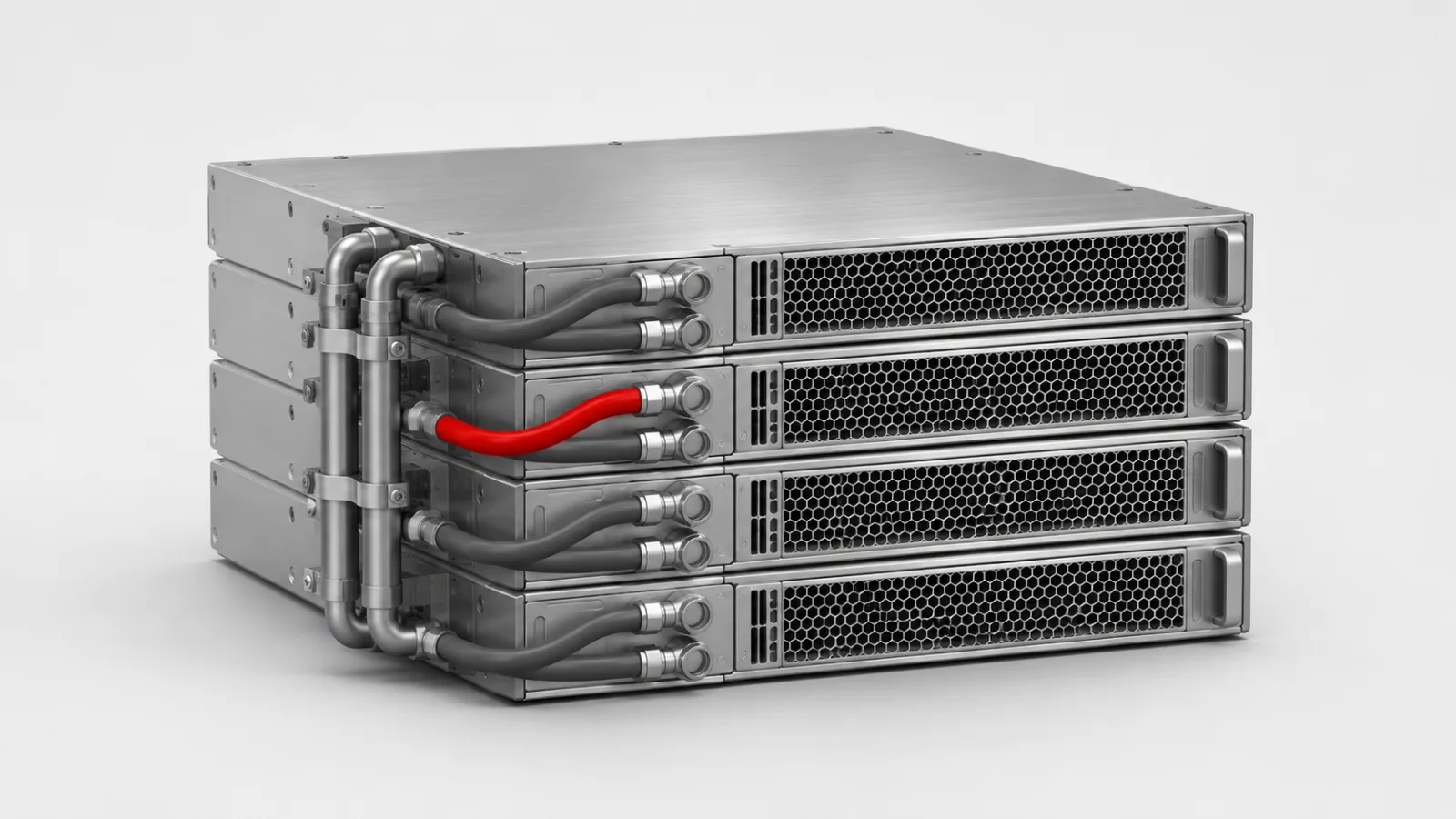
A rack holds 96 accelerators in 24 trays of four within 167 kW, twice the accelerator density of Maia 200 [1]. Second-tier switches, using optical links, join up to 128 racks into a superpod of 12,288 accelerators that share one communication model [1]. An accelerator can send up to 750 GB/s to any peer in the superpod when only some accelerators are using cross-rack links [1]. Liquid cooling removes more than 80% of the rack’s heat [1].
Claims and limits
Microsoft says that, against Maia 200, a full 96-accelerator rack delivers up to 7 times the token throughput and more than 2.5 times the performance per watt [1]. These are Microsoft’s own figures; the post gives no independent benchmarks, and it does not say when or in which Azure Regions Maia 300 capacity will be available [1].
Sources
Written and checked by AI from the sources below
Fact-checked by gpt-6.1-sol on · Editorial policy